 |
|
|
|
|


Celebrating the pipe organ, the King of Instruments |
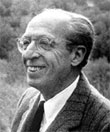

Aaron Copland
An Aaron Copland Centenary Tribute
He heralded the Common Man, and the uncommon organist, too. With a Fanfare, a Preamble, a Passacaglia and a symphony composed in Paris for his teacher’s debut in New York City, we explore some characteristic yet surprisingly little-known organ works by one of America’s most famous composers.

Program Broadcast dates:
- November 6, 2000
Links and Resources:
 Saint Paul’s Cathedral, San Diego
Cathedral of the Holy Cross, Boston:
Music played in the program
AARON COPLAND: Fanfare for the Common Man [1942] –Dorothy Papadakos (1954 Aeolian-Skinner; 2008 Quimby/Cathedral of Saint John the Divine, New York, NY) B&V CD-1996
AARON COPLAND: Preamble for a Solemn Occasion [1953] –Hans-Ola Ericsson (1987 Grönlunds/Luelå Cathedral, Sweden) BIS-CD-510
AARON COPLAND: Quiet City [1939] –John Wilds, trumpet; Alison Luedecke (1968 Aeolian-Skinner/St. Paul Cathedral, San Diego, CA) World Library CD-3070
AARON COPLAND: Episode [1940] –Hans-Ola Ericsson (1987 Grönlunds/Luelå Cathedral, Sweden) BIS-CD-510; also Rollin Smith (1883 Roosevelt/First Congregational, Great Barrington, MA) Repertoire Recording Society LP-12
AARON COPLAND (transcribed by John Fesperman): Passacaglia [1922] –Adrian Partington (1882 Henry Willis/Town Hall, Reading, England, UK) Priory PRCD687
AARON COPLAND (transcribed by Julian Wachner): El Salon Mexico, excerpt [1936] –Julian Wachner (1875 E. & G.G. Hook & Hastings/Cathedral of the Holy Cross, Boston, MA) OHS recording August 22. 2000
AARON COPLAND: Symphony, Number 1 for Organ and Orchestra [1924] –New York Philharmonic, Leonard Bernstein, conductor; E. Power Biggs (1962 Aeolian-Skinner/Philharmonic Hall, Lincoln Center, New York, NY) Sony Classical SMK 63155
Copland [born 11/14/1900] was an accomplished pianist who, despite an acknowledged antipathy towards it, understood the organ rather well. His First Symphony, written at the request of Serge Koussevitsky for Copland’s Parisian teacher, organist Nadia Boulanger, served as both her and his ‘debut opportunity’ back in the United States. After the Symphony’s premiere in 1925 shortly following its composer’s return from his stylistically liberating European studies, Copland wrote only one other original work for pipe organ, Episode [1940]. The other pieces on this program are transcriptions, one by Copland Preambule, one sanctioned by him Passacaglia, and two done because they needed to be. But, hey, we celebrate the Copland Centenary any way we can!