 |
|
|
|
|


Celebrating the pipe organ, the King of Instruments |

Day 1 - Haarlem
Monday, May 7
- Today’s Sites:
Saint Bavokerk • Müller organ of 1738
Basiliek Saint Bavo • (2 organs) Adema 1906/Adema 1924
Saint Bavokerk • Christian Müller organ of 1738
The Grote Kerk (Great Church) of Saint Bavo as it was originally named, replaced an older church on the same site. The current building is one of a series of churches in the area of the coast of the Netherlands that were built in the Brabantine Gothic style, adapted to local tastes, and sometimes called Kustgotiek (Coast Gothic). The choir was begun in 1370 by architect ENGELBRECHT VAN NIJVEL. It has a relatively heavy, closed look and small windows. It’s also very deep for what was intended as a parish-church, and the reason for its size is unknown.
 The transepts were begun in 1445 by architect EVERAERT SPOORWATER in Brabantine Gothic style. Originally the transept was lower than it is today; between 1480 and 1495 it was heightened with a section that is still easy to tell apart from the older parts.
Spoorwater also built the nave in two parts. In 1456 the outer walls of the side-aisles and the lower part of the western facade were built around the old church and tower, which were demolished in 1471. The nave was finished in 1478, in Brabantine Gothic style but with wooden vaults.
In 1502 work began on a crossing-tower out of stone, but since it proved too heavy, it was demolished in 1517, and a wooden steeple, covered with lead, put in its place.
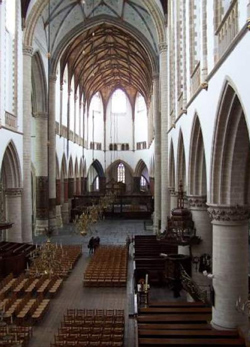
The church was originally built as a parish-church, and it became the cathedral of the new diocese of Haarlem in 1559.
The Saint Bavo remained a cathedral for 19 years only. In 1566 the first attacks on this symbol of Roman-Catholicism were carried out, and of the original typically Catholic decorations only the statue of Saint Bavo at the front remains. It has been a Protestant church since then.
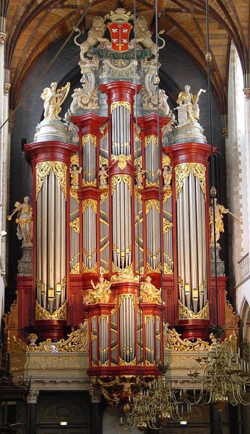
The great Müller organ of 1738 is arguably the most depicted organ in the world. It covers the whole west wall of the church and stands almost 30 metres (98 feet) tall. In the middle section are the Hoofdwerk and above it the Bovenwerk. The console is in the base of the organ case, with the large Rugwerk in front. This already large mass is flanked on both sides by two enormous Pedal towers in which the tin Prestant pipes are almost 11 metres (32 feet) in length. Its proportions are so well defined that one is not aware of its true size at first glance.
The organ case is of plain pine which has been painted and grained to simulate mahogany. It is further richly gilded and decorated with more than 25 larger than life- size statues, all made by JAN VAN LOGTEREN, a sculptor from Amsterdam. The pinnacle is crowned with two lion figures holding the coat of arms of Haarlem.
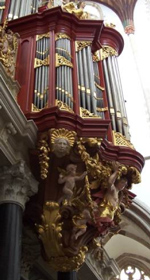
The organ was built by CHRISTIAAN MÜLLER, originally from Germany. The organ was reconstructed and major voicing alterations in 19th century style made by Witte in 1869. While the organ was mechanically restored by the MARCUSSEN firm from Denmark in 1961, little change was made to the sound, and only 11 of the original stops remained essentially intact. Between 1987 and 2000 FLENTROP, who maintains the organ, returned some of the voicing to what is believed to approach the original, and also made major mechanical repairs.
There are more than 5000 pipes, encompassing 64 registers. Unusually, all the pipes are made of various lead and tin alloys; there are no wood pipes. The key and stop actions are entirely mechanical, and the wind was originally provided by more than half a dozen immense wedge bellows located in rooms directly behind the organ. A few of those bellows are still in use, but only as reservoirs for the rotary fan blower, which along with the console lights are the only electrical devices connected with the organ. The organ was converted to equal temperament tuning during the late 19th century, and is pitched at a=435.
Timeline
- 1738 - Christian Müller
- 1869 - C.G.F. Witte, Modifications
- 1905 - Maarschalkeweerd
- 1961 - Marcussen & Sohn, Restoration
- 1987/2000 - Flentrop, Voicing Restoration
| HOOFDWERK Prestant I-II 16 Bourdon 16 Octaaf I-II 8 Roerfluit 8 Viola di gamba 8 Roerquint 6 Octaaf 4 Gemshorn 4 Quint-praestant 3 Woudfluit 2 Tertiaan II 2 Mixtuur IV-X Scherp VI-VIII Trompet 16 Trompet 8 Hautbois 8 Trompet 4 |
RUGPOSITIEF Praestant II 8 Quintadena 8 Holpijp 8 Octaaf 4 Fluit douce 4 Speelfluit 3 Super octaaf 2 Sesquialter II-IV Cornet IV (disc.) Mixtuur VI-VIII Cymbaal III Fagot 16 Trompet 8 Trechterregaal 8 Tremulant |
BOVENWERK Quintadena 16 Prestant II 8 Baarpijp 8 Quintadena 8 Octaaf 4 Flagfluit 4 Nasard 3 Nachthoorn 2 Flageolet 1 1/2 Sesquialter II Mixtuur IV-VI Schalmei 8 Dolceaan 8 Vox Humana 8 Tremulant |
PEDAAL Principaal 32 Praestant 16 Subbas 16 Roerquint 12 Prestant 8 Holfluit 8 Quintpraestant 6 Octaaf 4 Holfluit 2 Ruischpijp IV Mixtuur VI-X Bazuin 32 Bazuin 16 Trompet 8 Trompet 4 Cink 2 |
| Italics = new 1961 | Manuals C-d’’’ Pedals C-f’ |
||
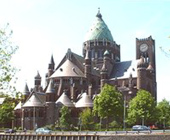
Basiliek Saint Bavo • (2 organs) 1906 Adema in the transept and a 1924 Adema in the gallery.
The Roman Catholic Cathedral of Saint Bavo was designed by PETRUS J. H. CUYPERS, (1827-1921) who was responsible for the design of many Catholic churches in the neo-Gothic style. He was born into a family where there was already a great deal of artistic interest. He was fortunate to attend classes in Paris given by the great French architect E.E. Viollet-le-duc, who became both a friend to and a major influence upon Cuypers.
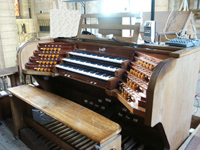
The building is a three-aisle cruciform basilica 100m/328ft long, 42m/138ft wide and 60m/187ft high, in a modern style which contains neo-Gothic and Arabic elements. The tower was added in 1927-30. The cathedral treasury contains valuable silver liturgical utensils and a reliquary with the remains of St Bavo, who is also commemorated by a statue at the east end of the church. Other features of the cathedral are the fine stained glass and the sculpture and pictures by well known Dutch artists such as Toorop, Derkindern, Bijvoet, Brom and Andriessen. The Basilica hosts the annual International Cesar Franck Competition.
The Transept Organ was built in 1906 and releathered in 1923 by the ADEMA firm. It originally used pneumatic key action, which was converted to electro-pneumatic in 1962 by VERMEULEN. From 1994 to 1998 a complete tonal grooming of the organ was carried out by FLENTROP.
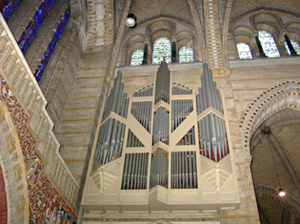
| HOOFDWERK Bourdon 16 Prestant 8 Roerfluit 8 Octaaf 4 Quint 2 2/3 Octaaf 2 Mixtuur IV-V Trompet 8 Klaroen 4 Tremulant |
ZWELWERK Prestant 8 Gamba 8 Zweving 8 Bourdon 8 Prestant 4 Gemshoorn 4 Piccolo 2 Quint 1 1/3 Cymbel III |
BOVENWERK Holpijp 8 Quintadeen 8 Prestant 4 Roerfluit 4 Octaaf 2 Sesquialter II Scherp IV Kromhoorn 8 Hobo 8 |
| PEDAAL Contrabas 16 Subbas 16 tr. Octaaf 8 Gedekt 8 Superoctaaf 4 Bazuin 16 Trombone 8 |
KOPPELS PO-HW ZW-HW HW-Pedaal PO-Pedaal ZW-Pedaal |
Vrije-combinatie Tutti-trede Tongwerken af Auto Pedaal |
Timeline
- 1906 and 1923 - Joseph Adema
- 1952 - Joseph Vermeulen, Reconstruction
- 1962 - Joseph Vermeulen, Action Conversion
- 1994–1998 - Flentrop, Tonal grooming
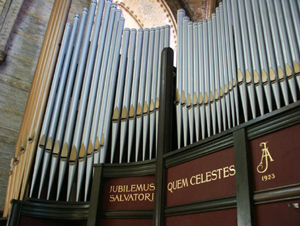
The Gallery Organ, or Willibrordorgel, was originally built by JOSEPH ADEMA for Saint Willibrodus Buiten-de-Veste in Amsterdam between 1921 and 1923. It was moved to Haarlem in 1971 when that church, also designed by P. J. H. CUYPERS, was demolished; its conservation was assured by the establishment of a Foundation the same year.
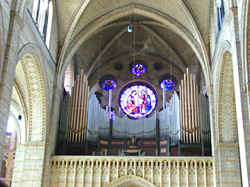
The organ has been in the care of “ADEMA’S KERKORGELBAU” under the direction of HUBERT SCHREURS, his son ANTOINE SCHREURS, and since 2002 RONALD VAN BAEKEL, without interruption since its installation in Haarlem until the present day.
Timeline
- 1924 - Joseph Adema
- 1971,1978 - Hubert Schreurs
- 1990, 1991, 1995, 1998 - Antoine Schreurs
| HOOFDWERK Violon 32 D Principaal 16 Bourdon 16 Prestant 8 Fluit harm. 8 Portunaal 8 Fluit harm. 8 Quint 5 1/3 Octaaf 4 Gemshoorn 4 Doublet 2 Mixtuur IV-V Cymbale IV Ripieno II Cornet III-V Fagot 16 Trompet 8 Klaroen 4 |
POSITIEF EXPR. Viola Major 16 Principaal 8 Baerpijp 8 Roerfluit 8 Viola 8 Vox coelestis 8 Viola 4 Fluit douce 4 Quintviola 2 2/3 Viola 2 Mixtuur II-III Cymbale III Sesquialter II-III Engelse Hoorn 1 Trompet 8 Kromhoorn 8 Schalmei 4 Tremulan |
RECIET EXPR. Quintadeen 16 Fluit harm. 8 Nachthoorn 8 Viola di Gamba 8 Unda Maris 8 Quintadeen 8 Salicet 4 Fluit harm. 4 Nasard 2 2/3 Octavin 2 Terts 1 3/5 Larigot 1 1/3 Flageolet 1 Trompet harm. 8 Fagot hobo 8 Clarinet 8 Vox humana 8 Tremulant |
KROONPOSITIEF Prestant 8 Holpijp 8 Fluit harm. 8 Salicionaal 8 Octaaf 4 Roerfluit 4 Quint 2 2/3 Octaaf 2 Mixtuur IV Cornet III Baryton 16 Trompet 8 Klaroen 4 |
PEDAAL Majorbas 32 Openbas 16 Contrabas 16 Subbas 16 Quint 10 2/3 Openbas 8 Gedekt 8 Cello 8 Openfluit 4 Octaaf 2 Ruispijp II-III Contrafagot 32 Bazuin 16 Fagot 16 Trompet 8 Klaroen 4 |
- Day 2 - Tuesday, May 8
Alkmaar, Saint Laurenskerk • (2 organs) Covelens 1511/F. Schnitger 1725
Leeuwarden, Jakobijnerkerk • (2 organs) Müller 1727/Vermeulen 1977
Groningen, Niewe Kerk • (2 organs) Timpe 1831/van Vulpen 1958
Groningen, Martinikerk • (2 organs) Schnitger 1692/le Picard 1742 - Day 3 - Wednesday, May 9
Noordbroek, Hervormde Kerk • Schnitger 1696
Farmsum, Hervormde Kerk • (2 organs) Lohman 1829/Meijer 1958
Zeerijp, Saint Jacobuskerk • Faber 1651
Leens, Saint Petruskerk • (2 organs) Hinsz 1733/Mense Ruiter 1982
Leeuwarden, Jacobijnerkerk (Choral Concert) - Day 4 - Thursday, May 10
Kampen, Bovenkerk • (2 organs) Hinsz 1743/Reil 1999
Zwolle, Saint Michaeliskerk • Arp & F.C. Schnitger 1721
Zwolle, OLV Kerk • (2 organs) Maarschalkerweerd 1898/Kaat & Tijhuis 1986
Zutphen, Saint Walburgiskerk • (3 organs) Bader 1642 /Timpe 1815/Hillebrandt 1813 - Day 5 - Friday, May 11
Nijmegen, Saint Stevenskerk • (4 organs) König 1776/Clerinx 1850/Assendelft 1750/Unknown 1675
Den Bosch, Saint Jans Kathedraal • (2 organs) Hocque 1617/Vermeulen
Oirschot, Saint Petruskerk • Smits 1845
Helmond, Saint Lambertuskerk • (2 organs) Robustelly 1772/Smits 1865 - Day 6 - Saturday, May 12
Utrecht, Saint Nicolaïkerk • (3 organs) Marcussen 1953-1956 /van Vulpen
Utrecht, Nationaal Museum van Speelklok • Witte 1883
Utrecht, Domkerk • Bätz 1831/de Swart 1538
Loenen aan de Vecht, Hervormde Gemeente • Flentrop 1950 - Day 7 - Sunday, May 13
Morning Services at the Westerkerk • Duyschot 1686/Flentrop 1963
Hands-on flue pipe voicing seminar by Allan Ontko
Amsterdam, Oude Kerk • (2 organs) Vater 1726/Ahrends 1965
Amsterdam, Nieuwe Kerk • (2 organs) Schonat 1655/van Hagerbeer 1651
Recital by Arjen Leistra - Day 8 - Monday, May 14
Zaandam, Flentrop Orgelbouw
Zaandam, Westzijderkerk • Flentrop 1976
Haarlem, Philharmonie Amsterdam, Concertgebouw (Orchestra Concert) • Maarshalkerweerd 1891 - Day 9 - Tuesday, May 15
Keukenhof Gardens
Leiden, Hooglandsekerk • (2 organs) de Swart 1565/Lohman 1866
Gouda, Saint Janskerk Stained Glass Tour
Gouda, Saint Janskerk • (2 organs) Moreau 1738/Leeflang 1975 - Day 10 - Wednesday, May 16
Delfshaven, Oude (Pilgrimvaters) • (Kerk Bätz & Witte 1855)
Rotterdam, Saint Laurenskerk • (4 organs) Marcussen 1959/1959/1973/van Vulpen 1963
Recital by Arjen Leistra
Schiedam, Grote Kerk • (Flentrop 1975)
Maassluis, Grote Kerk • (Garrells 1732) - Day 11 - Thursday, May 17
Delft, Oude Kerk • (3 organs) Witte 1857/1873/Hess 1870
Delft, Nieuwe Kerk • (Bätz 1839)
Rotterdam-Kralingen, Hoflaankerk • (2 organs) van Vulpen 1966/Klop 2005
Recital by Arjen Leistra and Marian Jaspers Fayer